That's really cool - excellent idea and well done!

Oct. 28, 2023
110
-
-

This brings up an interesting question. Why would a Japanese company label a prototype in english, for any reason at all? If it isn't being marketed, why use a foreign language?
Thanks,
barondla -
You're right... I've wondered about that a bit as well... however it doesn't seem unusual, given that a lot of Lenses made in Japan have been labeled in Roman Alphabet letters since the very beginning of the optical industry there. Take a loot at this japanese lens from 1938:
No sign of any Japanese letters on there and that was during peak nationalism in Japan. So an inscription in English in the 80s doesn't seem surprising. I have thought about German letters as well (given the cooperation with Zeiss) but I wasn't able to make much sense of it, even though words with K are quite common in the German language.
-
But, these lenses were probably meant to be sold in foreign markets. It would make sense to label them for the market they were going to. Lens ID could be changed easily by unscrewing the lens ring and replacing it with one printed in a different language. A prototype lens isn't meant for sell. So why use a foreign language? Perhaps to "hide" it from competitors?
The Pentax Q lenses have Kanji on them. I'm sure they thought it added to the Q mystique. Haven't seen other lenses adorned with Kanji. It has probably been done, I'm just not aware of it.
Thanks,
barondla -
I doubt it's to hide it from competitors. Lens inscriptions (even on lenses meant for the japanese market as far as I know) have almost always been in Roman letters. I think that's mainly because of the heavy influence from the german optical industry in the early days. The lens above was pictured in an ad from 1938 (peak nationalism in Japan) where everything is in Kanji, except the specific lens names and inscriptions. So it surely was aimed at a japanese audience and from some translations I got the ads never grow tired of emphasizing the japanese origin of these lenses etc. Yet still they get names which evoke German sounding names, like Tessar etc.
I've actually never seen a single lens with Kanji on it, even japanese made industrial lenses, used in Japan are most of the time labeled in English at least from my limited experience.
I still don't have a firm grasp on the whole thing, but at least I'm starting to get a better feel for the overall Tomioka timeline. Here's the latest version:
-
Shot with a Tamron Noritsu 48.5 mm f/2.8 enlarging lens:
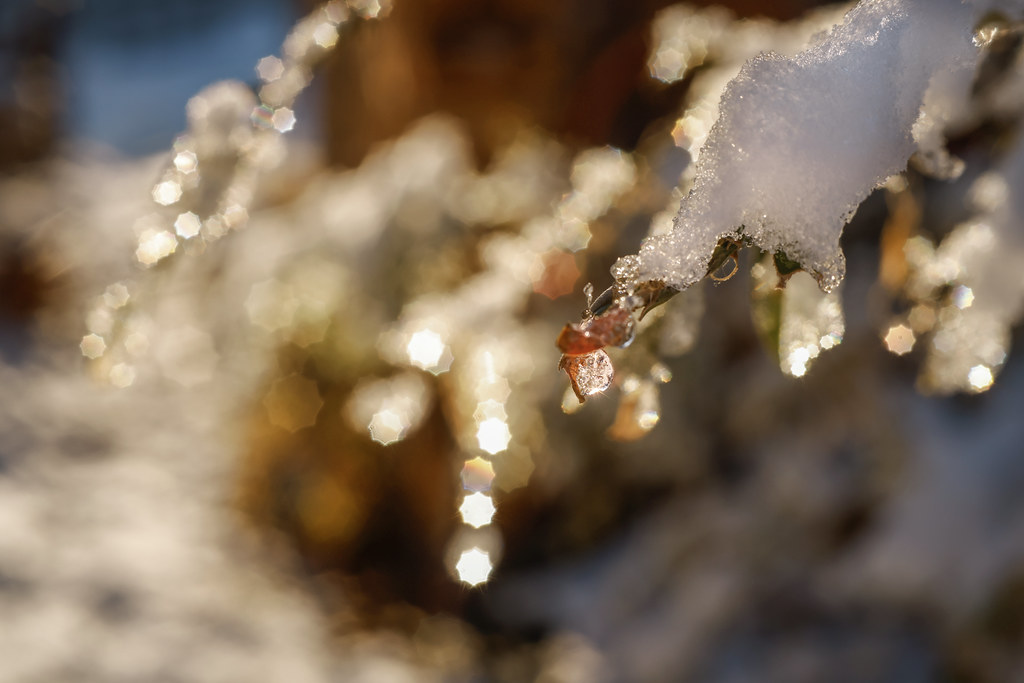
Christmas is in the air... by simple.joy, on Flickrand this one with a Fuji P-Fujinon 2 1/2 inch f/1.7 (projection) lens:
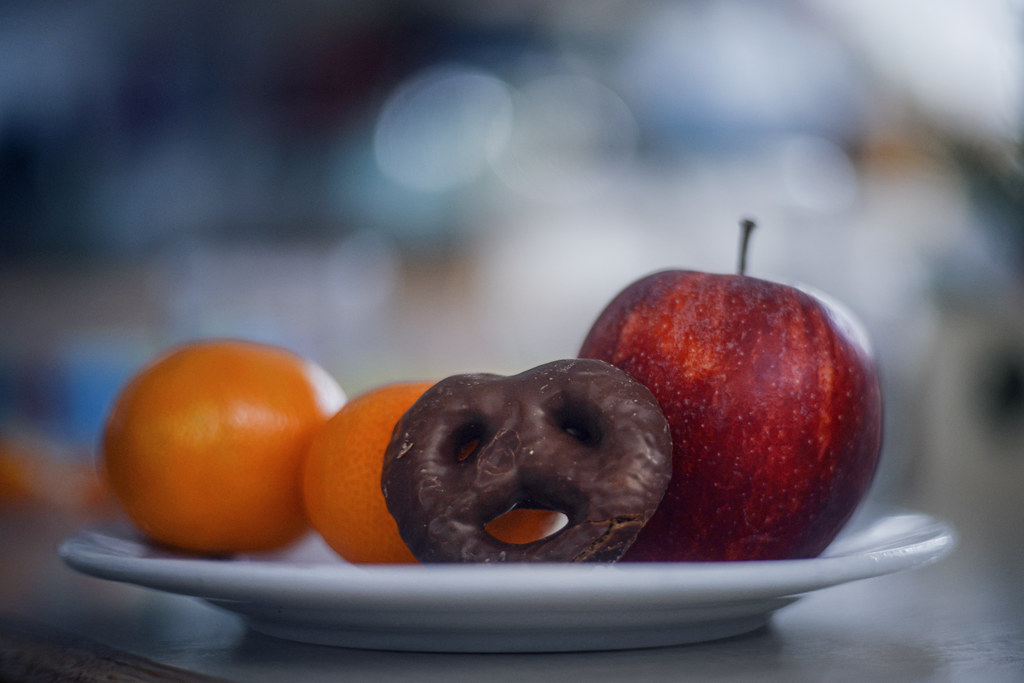
Bokeh is no laughing matter... by simple.joy, on Flickr -
Questions that may be useful, or may just show my ignorance:
The letters look to have been engraved and then filled. Was the engraving done by hand or machine?
The letters are monospaced. The font used is very familiar to me: typewriter-like. Were the metal holders themselves made in Europe/USA, or with an imported machine?
Does the use of the decimal point indicate American involvement, or did German lenses not use a comma in those days? (In Britain, as opposed to the USA, the decimal point is above the line, not on it.)
Does the use of both ft and m mean anything, or was there always an international format on lenses when labelling focussing distance?
David
-
A fisheye lens from the other end of the size spectrum. An Ukranian made Arsat 30 for the Pentacon 6 medium format film camera. I use the lens with a P6 to Pentax 645 adapter. The lens is large with the front element being about 110mm. It is well built, but the adapter is a little lite weight and care must be taken when attaching or detaching the lens. It performs well when stopped down some. Rear of lens is threaded for filters and as ususal a filter must always be in place since it is part of the optical system. I only have the clear filter. Need to hunt down some others.
This was taken at f8 at 8 seconds, ISO 100. I walked out onto the bridge and sat on the concrete lane divider with the tripod. It was a long time exposure so I had to shoot lots of frames to get one without cars or camera blur. The semi trucks bounce the whole bridge when they go by.
.
Thanks for looking,
barondla
-
It certainly is not. Unless, chocolate is in involved :). The Tamron has a neat aperture shape.
Thanks for sharing,
barondla -
Thanks a lot for your observations and interesting questions... it made me look at the lens again and I've realized that the labeling is indeed not quite uniform in terms of spacing and angle of the single letters. Not sure what it means for how it was made...
I'm not sure what the decimal point means, but I guess it's likely an indication that this lens was not made in Germany (which was my second suspicion) but Japan. Everything else is pretty much out of the question in 1938, due to the political situation. The most likely manufacturers (given the connections of Omiya Photo Supply, responsible for the famous Hansa Canon Camera, the first ever Canon-made camera, featuring a Nikkor lens) are the following:
1.) Nippon Kogaku (later Nikon)
2.) Tomioka Kogaku
3.) Another Japanese manufacturer
4.) Some German manufacturerFrom the details on the markings there are more things pointing towards Nippon Kogaku being responsible, however I don't know why a.) they wouldn't put their own name on it (given that they did on the 1936 Hansa Canon camera lens) and b.) I have no idea if the serial number No 816 is realistic, given that they would have already made lenses in significant numbers for two years. On the other hand, it's impossible to say when this particular lens was made, so who knows.
I also thought about Seiki Kōgaku Kenkyūjo (later Canon) being responsible, but it seems impossible, given they released their first lens in 1946.
-
Here's one more shot with the interesting Fuji P-Fujinon 2 1/2 inch f/1.7 (projection) lens:

In part wholesome by simple.joy, on Flickr -

A Snowflake in the Christmas tree.
Drawn by Leitz Focotar 50mm f:4.5
-
Very nice! Which version of the Focotar do you have? The Schneider-made one or one of the earlier Leitz lenses?
-
I think this is the Schneider version. There is engraved Leitz Wetzlar at the lens barrel. It's Serial Number is between 11458893-12364598. So I guess, according to Delta Lenses ( deltalenses.com/product/leitz-wetzlar-focotar-50-lfe-4-5-v5/ ), it's V5: LFE. But why do you ( and Delta ) think it's made by Schneider?
Did you look at the bokeh balls in the first picture? I forget to mention that I used ~10 degrees swing which distorted those balls.
Btw. You have shown pictures made with Focotar II. Do you know what are the differencies between Focotar and Focotar II ?
-
Excellent images. I noticed something was up with the bokeh balls. There are measurements of 5 different Leitz Focotar 50 lenses here: www.ultravioletphotography.com/content/index.php?/forum/639-uv-lenses-non-helicoidal/. Lots of this info pertains to UV response. The Focotars are some of the best "accidental" UV lenses around.
Thanks,
barondla -
There's a short writeup here (not nearly finished): deltalenses.com/the-leica-story/
I don't know where the Schneider theory originated, but it seems very likely due to the different serial number system, as well as clear differences in style, materials and finishing to the Leitz made lenses. If I remember correctly the story was something like that:
1.) Leitz made several Focotars 50/4.5
2.) some review in a magazine appeared and critizised the Leitz Focotar for too much field curvature
3.) Leitz (perhaps not quite finished with developing a successor to the Focotar) made a deal with Schneider, who created a lens of similar quality with improved field curvature for them.
4.) Leitz finished and released their Focotar-2, a clear improvement in almost every way and so in-house production took over once again.Why it's likely?
- serial number seems to match the Schneider system, not the one of Leitz
- Schneider Kreuznach made a number of Leitz labeled lenses over time, so it's not exception
All of this is from top of my head, so I may misremember some things... it's a very good lens though.
Very interesting! I have noticed the strange shapes, but didn't think of swing movements... some shapes like that can appear when bokeh balls are actually some kind of reflected/distorted light sources as well. My bellows doesn't feature swing movement, so I've no experience with it, but quality seems fine for 10 degrees. The Focotar (LFE) is a very good lens for T/S movements in my experience. The Focotar-2 is significantly better though.
It depends... do you mean the Focotar II (which is the latest 100 mm enlarging lens made by Leitz) or the Focotar-2 50 mm f/4.5? I've made several images with both of those. The Focotar-2 50 mm f/4.5 is remarkable in terms of sharpness and incredible ability to hold a lot of its images quality even when tilted extensively.... It's quite remarkable for a normal lens.
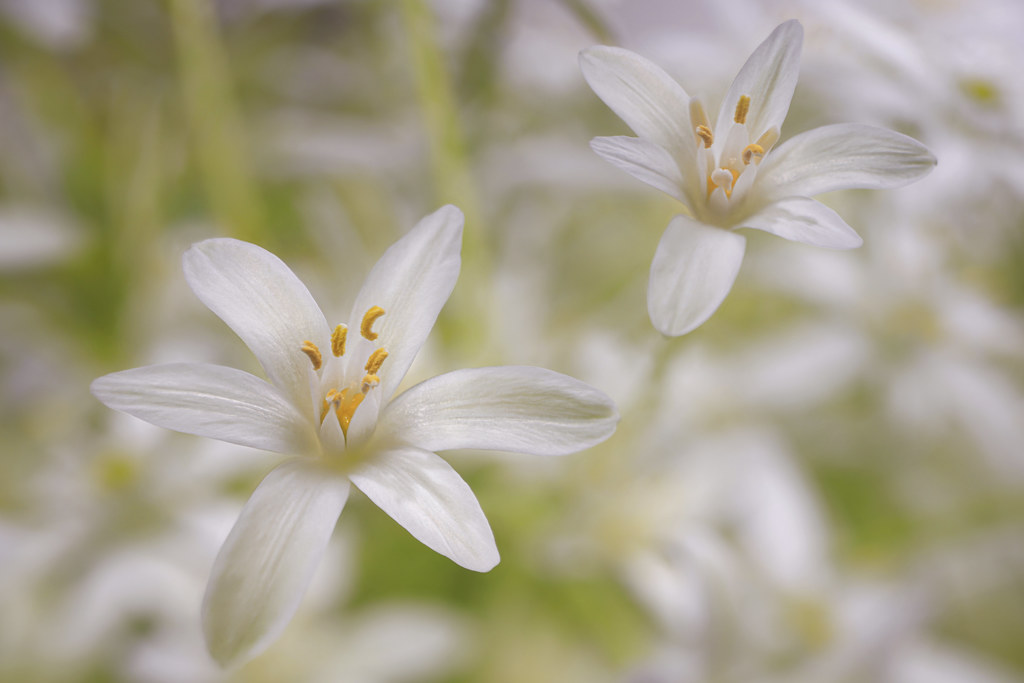
Twofold unfold by simple.joy, on FlickrSo far I've not been able to find a better normal lens for that than the Focotar-2... Apart from this feature, it does have nice rendering (like almost all Leitz lenses) but nothing really special. It's clearly not a fast lens at f/4.5 and it's usually quite expensive, because it still is highly interesting to both people with enlargers as well as macro enthusiasts. Someone specializing in astro-photography also told me that the Focotar-2 was rumored to be quite good at that. I did some tests, but I'm not sure if it really is anything special in that regard.
The Focotar II is a similar story, but even more extreme in some aspects...
-
Very interesting info even if I don't take UV shots. Thank you!
-
This makes sense, I believe the serial numbering shows the origin of the lens.
You have written a nice story there. The Zenotar type Componon-S 50mm f/2.8 is a very interesting lens. I guess it was the only one of that type in Componon-S line with it's big max aperture. The longer (and maybe later) Componon-S lenses were double Gauss type with six elements.
Btw. it looks like my Focotar's max aperture was a little limited by the iris. Maybe for image quality reasons. When I open the aperture it'll never be full open.
Focotar could be a f/3.5 or f/2.8 lens if not limited.I did mean Focotar-2 but I did write straight from my memory without checking the facts...
And here I tried mimicking simplejoy but failed again... At least I got mother and child in focus with f/11 and 9 degrees of tilt.


