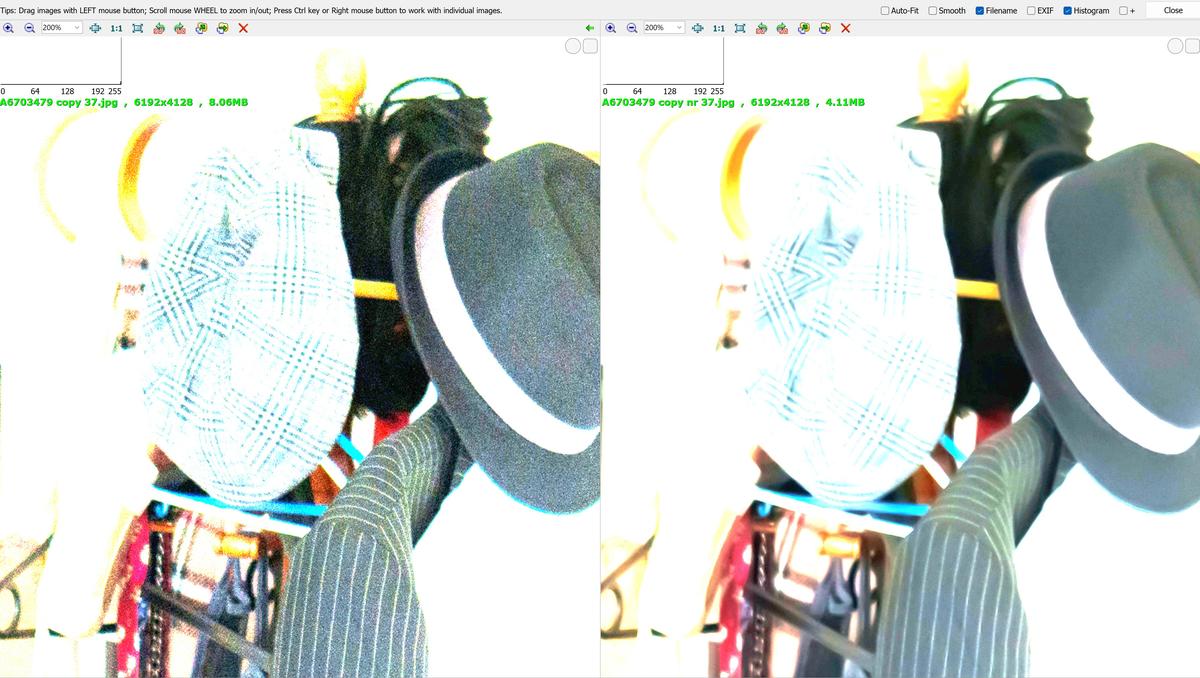
With G2 having a dark area with about 15 raw value and having an SNR of more than 1, the raw data has a ISO DR of log2(15778/15) = about 10 EV, FWIW.

June 27, 2025
129
-

-

its not increasing DR as demonstrated in the image i posted. i added NR to the raw then pushed up exposure compared to just pushing the original raw.
-
This kind of noise removal (like you displayed) is pure c**p. If it is your camera NR, then turn it off and use proper NR in postprocessing.
But even processes in this way DR is increased - if DR is calculated as maximum signal / noise floor - because noise is much less.
I think you are talking about some different, much more subjective definiton of DR - ability to record [overexposed] highlights and deep shadows into same image, independently of noise level. -
ISO - the exposure index - is clearly defined by I.S.O. Standard 12232. Nothing said in this thread alters that.
-

How about we start from scratch
What is DR to you?What happens when then sensor records data in a tonal value, but in that tonal value all that is recorded is noise can we call that data in that tonal value part of the DR?
If all that data collected by the sensor in a tonal value is nothing but noise, can we say that data is contributing the DR the camera recorded?
If that noise is not contributing to the data creating a image can we not say those tonal values falls outside of what the recorded DR of the camera?
If the noise is the limiting threshold to the tonal range that a camera can record, is it not safe to say that noise is the limit to deepest shadows that a camera can record?
-
I am reminded of the 'dynamic range of a orchestra' (about 90 dB) where the lower limit was audibility of any kind, musical or not. In other words "noise" was included in the range, not separated out like ISO does. In that case, donning earmuffs would reduce the DR ... 😉
-
the NR was applied in PP photoshop and topaz. as i keep saying noise reduction does not increase DR period. the cap clearly shows this.
-
old age reduces hearing DR 😁 i wound up an old watch the other week and had to ask my daughter if she could hear it ticking and she said clearly , i couldnt 😌
-
All Dolby audio noise reduction uses filters. There is no Dolby D. B & C were used on cassettes.
-
Dolby D = Dud, it was all marketing, I owned an electronics repair shop back in the 70s and repaired many a cassette deck including hi end Disco consoles where the finals cost $120 back then, one guy had gone through 4 pairs and they kept blowing till i discovered that the drivers where over biased so i just turned them down a little and job done 😎 they were the good old days, audio sig generator, RF sig generator, 4in osiliscope and a frequency counter ,couple of hand made lodgic probes and away you went including transceiver repairs and modifacations. and a good 3v mini scope instant iron.
-
Apparently we are talking about quite different things.
We (I mean most technical people here) use DR in meaning "maximum signal / noise floor in recorded data"; noise floor is often taken as signal value, where SNR (signal to noise ratio) = 1. As sensors [usually¹] are linear devices, then this roughly corresponds to ability record scene DR without too much noise.
You are mostly concerned about clipping highlights - at least your examples show that. In old film times this was important property, esp because film is not linear media - you could record wide scene DR (say 14 stops) into much narrower film DR (say 8 stops) and I think most talk about DR concerned particular film ability to record some dynamics both in higlights and shadows at the same time.
Those definitions are not exactly compatible - both characterize some range of recordable information, but are based on totally different ideas.
For first meaning (technical definition) it is clear that noise removal (NR) lowers noise floor and thereby increases DR.
For second meaning (visual definition) noise is almost not important and NR does not change almost anything - higlights will not be recovered, (deep) shadows are not lifted and so on.
¹ There may exist digital sensors, having non-linear response - but those would be quite hard to use in everyday photography, making color conversion algorithmically complex task. Then there are sensors (eg Sony automotive), which contain pixels with different sensitivity - both are linear, combining them one can get very wide dynamic range.
-

But the Exposure slider doesn't alter exposure, it's just named "Exposure" and only adjusts the brightness, modifies the way the data is displayed. How do you know that it doesn't weight the adjustment or add a perceptual intent?
Also, again you're looking at an RGB computer screen post conversion to your chosen colour profile. The DR of the screen if fixed. So it's not possible to observe a higher DR in any file directly. All you're doing (paradoxically) is compressing the DR in the RAW until it fits within the fixed DR of the screen. That's basically what the basic sliders do, stretch and compress the data so you can make it fit into the fixed DR of your output device with pleasing colour and contrast.
I'm not quite sure what it is you think you're doing.
-
noise reduction is no different than veiling glare, veiling glare reduces DR period, you have the equipment do the test to back your claims.
-
If we refer back to Alan‘s initial question, the answer is quite clear: nobody here! 😂
David
-
This I can agree :)
But what to do - many people, not able to create good images, but having technical background (like me), like to discuss over technical terms - it is much simpler than create something enjoyable... Sure such discussions often deviate very far from real photography. -

Hi All
Just arrived at this thread after a while away. I have to say my impression of the thread is spoiled by Donald's belligerence, arrogance and dismissal of useful and educational posts. I'm sure Donald has useful things to say, but adoption of a politer and more humble approach would significantly improve the attractiveness of this thread and be very welcome. That's my contribution to the interpersonal stuff :-)
Now, to the thread itself...
The way that digital sensors work means that the most critical factor if you are aiming for a conventional technically high quality image is highlight exposure. Fully clipped highlights are unrecoverable so it is the photographer's responsibility to ensure that important highlights are not clipped (we can let specular highlights go).
Assuming the exposure has been pulled off to preserve the highlights, the dynamic range is then determined by how much noise there is in the dark tones. This is a subjective judgement, some people can tolerate more noise than others and so will enjoy a wider dynamic range than others. But at some point the noise levels will be so high and the colour/tones so damaged by the noise that no one will accept it in their images. This must surely represent the noise floor for any photographically useful image.
Where noise reduction has been applied to the darker tones and reduced the noise in those tones, allowing us to make use of darker tones without the horrors of excess noise and without being forced to clip them to black to hide it, it is entirely reasonable in my book to claim that dynamic range has been improved.
About noise: Noise can roughly be split into read noise (added by the electronics and added after ADC) and photon shot noise (which is a characteristic of the quantum nature of light and happens at the point of capture before ADC).
The reason why analogue gain (aka increasing the iso setting) can be useful is because it (in some cameras) amplifies the signal. Because read noise is added post signal amplification this means raising the ISO boosts the signal before read noise is added, reducing the ultimate proportion of read noise at the end. However, amplification does not reduce photon shot noise because this exists at the beginning and therefore gets amplified along with the signal. The final values have equally boosted signal and shot noise. Modern cameras tend to have low read noise compared to early cameras, so boosting the amplification doesn't gain you as much in reducing read noise as it used to. These days photon shot noise is the key player and the way to control that is more exposure.
It's also worth bearing in mind that because boosting amplification drives the highlights into clipping quicker, you also lose highlight dynamic range when you raise ISO, which means the improvement in shadow noise might make the image look nicer, but you ultimately lose overall dynamic range.
The dual gain thing has always been a bit of a mystery to me, the info about using a capacitance change to reduce the sensor sensitivity and therefore to allow more exposure (which reduces photon shot noise) is very helpful (assuming I have understood what has been explained).
On the uneven DR plot, Canon were notorious for messing about with exactly how they implemented ISO settings years ago, particularly the settings in between full stop increases. I'm not entirely surprised to see unevenness in performance at different ISO settings as a result.
-
Thanks David,
A very useful post. I wasn't aware that read noise is added after the amplification.
Alan
-
There's a parallel with Sigma-Foveon cameras in their low-res raw capture. On-sensor, pixels are binned 2x2 connecting the outputs of four pixels together in parallel. The effect of that is, for a given exposure, four times the current goes into a four times bigger capacitor resulting in the same voltage output from the now big pixel which is the average of the previous four pixels.
P.S. Shot noise is also reduced.