Pure epistemological idealism...

May 7, 2023
188
-

-
It is called snowflakism... pedantic Karens/Kevins that get their knickers in a twist about anything.
-

I always thought the compression was as follows. Wide angle shot from close distance:
Same scene from a longer distance:
So the 'compression' goes along the line of view. The objects appear closer to each other, and the ratio of angular sizes of objects gets closer to the ratio of their actual sizes. I don't see how it depends on the distance at which the photograph is viewed.
-

I have a shot that well-illustrates so-called compression:
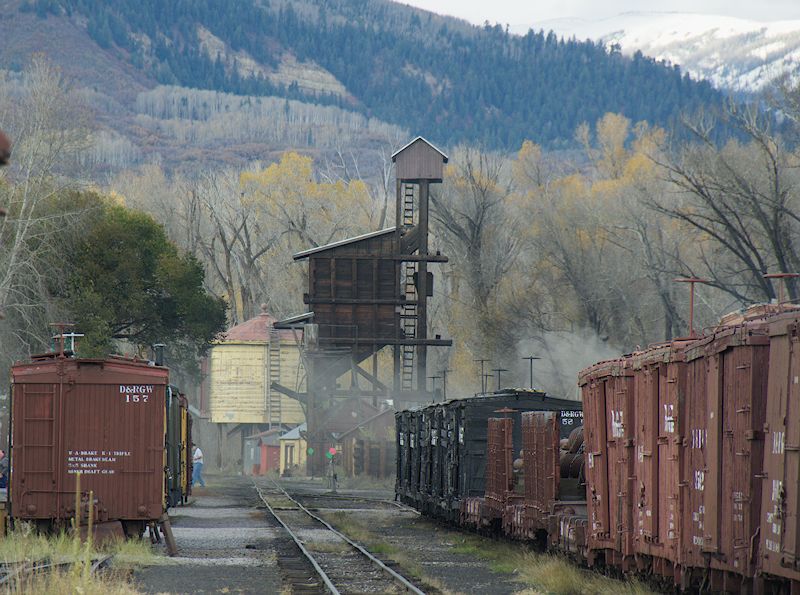
I have a wide-angle shot taken from the same position, and I can re-produce this exact composition by cropping to a teeny bit of the center. I'd post it, but I'm away from the computer where it resides. Anyway, if you stand at that position and regard the scene with your eyes, the mountains don't look so close, and they aren't.
Thing is, this "crop" looks compressed whether "cropped" in-camera with the telephoto or cropped in software from the wide-angle shot take at the same place. It's just a sense of depth induced by considered composition.
-
The compression is caused by the use of a telephoto lens for the second shot. If you used the wide-angle lens from the same position as the second shot, you would see no compression. The compression is caused purely by the use of the longer focal length and not by the change in camera position.
-

Different focal lengths allows for different camera positions.
If he used a wide angle lens for that second shot and then cropped to match, the two photos would look exactly the same. The camera position stays the same, so the relative distances stay the same, no matter the lens used.
-
Thanks, that is a good example.
I downloaded your image and displayed it at its native size of 800 pixels wide against a black background on my computer screen. It is then very easy to stand back to a distance of ten or twenty times the length of the diagonal and view the image. On my screen, the diagonal is about 17cm. I can step back and view the image from about 3 metres away.
If you imagine that you are looking through a small window at a distant scene, the perspective then looks normal with no signs of compression. The compression appears only when you move much closer to the image.
-
No, had I used a wide-angle lens from the second position, it would have been the same 'compression' - as I said, "objects appear closer to each other, and the ratio of angular sizes of objects gets closer to the ratio of their actual sizes. "
The compression happened because I moved away from the subjects, it wasn't the longer lens that changed the ratio of apparent angular sizes of the objects.Also, it still has nothing to do with the distance you view the photograph at.
-
Ok so here's more to illustrate that the 'compression' depends on the distance to the subject(s) not on the focal length.
-
This shot shows the screwdrivers are the same size:
-
This one is taken close-up with wide angle:
-
This one is taken at a distance with a longer focal length:
-
... and this one is taken at the same distance as the previous one (#3) but with a wider lens
As you can see the relative angular sizes of the screwdrivers in (3) and (4) are the same.
If we heavily crop #4, it'll be pretty much the same as #3: -
-
So, when you look through binoculars or a telescope, things do not look closer? Everything looks the same distance away as when you view the scene with the naked eye?
-
See my message above with more example shots.
'Compression' is not about how far away you feel the objects are, it's about their relative angular sizes and apparent distance between the distant objects. As you can see, in the shot #2 the screwdrives are apparently far away from each other, but in #3 the apparent distance between them is not so big, and the apparent sizes of the screwdrivers (angular sizes) are almost the same. -
That is magnification, not compression.
-
In fact the whole night sky is heavily 'compressed' in this sense, it looks like everything is on the same sphere, we don't perceive the huge distances between the stars - which led to the concept of celestial orb(s) in ancient times.
Looking through a telescope (magnification) doesn't change that, the celestial objects are still seemingly at the same distance from the viewer. -
Ah, now we are getting to where the confusion/disagreement lies. Telephoto compression is exactly about how far away objects appear to be. It is about our perception of depth in a 2-D image.
When an image is magnified, our brain automatically assumes that objects have not all suddenly grown in size. Instead, we perceive the magnification as meaning that everything has got closer to us. Our perception of depth in the image changes and we imagine everything in the image being closer. That is telephoto compression. It is caused purely by magnification of the image.
-
Magnification causes the appearance of compression. Compression is an optical illusion; it is about our perception of depth in an image. That perception of depth becomes compressed when the image is magnified. Our brain interprets the magnification as meaning that everything in the image is closer to us.
-

That is the way I see it as well.
I look at it like this. Lets say you have object A 2m away from you and object B directly behind A 10m away from you and you look at them through a lens at Xmm focal length. Now, let's assume we increase the focal length such that the magnification is 2x what it was originally. Object B will now appear to be 5m away from you and object A will appear to be 1m away from you.
Originally, B was 8m behind A. After zooming in B will appear to be only 4m behind A while neither objects had physically moved.
-
Your link to the wiki article basically describes what I said above, there's nothing in the article about the viewing distances to final photographs and nothing about the image magnification.
"Note that linear perspective changes are caused by distance, not by the lens per se"
So it's not about how close you are to a photograph and not about 'telephoto' per se.
Upd: right I found the article talks about the viewing distance down the bottom. But what they describe doesn't define the 'compression'. They don't say the compression doesn't depend on the shooting distance to the objects, quite the contrary.
They say the effect is created by the shooting distance but fades out at some extreme viewing distances. -
The relative angular sizes of objects didn't change and perspective didn't change, so you didn't actually change the compression. You magnified everything at the same rate, distances and sizes. Had you moved your PoV, you'd have changed the relative apparent sizes of the objects.


