Just for fun...

It needs some work to subdue the colors and tame the halo but I'm not near a computer and this is just a basic idea, shown from mobile.


Just for fun...
It needs some work to subdue the colors and tame the halo but I'm not near a computer and this is just a basic idea, shown from mobile.

Thanks for the heads up to the BBC. They convince me. It's a technique worth playing with. 1 and 2 are first steps on a path and I look forward to seeing where it takes you.
I like 4. A musical instrument and links to what an instrument can do. The ghosting means the instrument remains the subject while the person and music are associated with it. If they hadn't been ghosted, the player would have been assumed to be the subject.
You live in such a beautiful part of the world!
It's too perfect. C&C here is too easy so I wont try to detail the following. Framing from the trees and the foreground shadows. Balance. Control of DOF with a special note for the path and the importance of the path. Exposure and colour (while getting some blue in the sky. Exposure has to be perfect to do that.)
Achingly beautiful.

The exposure does not actually need to be perfect to get the blue sky in that scene. It can be less than perfect because what matters is that the sky is not clipped in the raw data.
The quickest and easiest way I know to keep blue skies in a single shot for that type of scene is to set manual mode with base iso.
Set the widest aperture that gives the DOF you want and then ignore the metering system because it can be easily fooled and clip the sky in this type of scene.
Set the slowest or near enough to the slowest shutter speed that avoids clipping of highlights according to the camera's histogram and/or blinkies.
You then set the final image lightness to taste in post.
As long as you don't clip the sky in the raw data (easy enough to do as described above) the sky will be blue.
An alternative is to take two exposures using ETTR and then blend them in post.
I'm a sucker for reflections in water. I like this scene very much. I like the few blades of grass in the foreground that help to give depth to the scene.
However I am not a fan of blue fringes in foliage as you have across the tops of the trees. They are easily removed in Ps or PSE by painting over them on a separate layer set to Color Blend Mode. You can use Select Color Range and the Magic Wand to quickly select those blue fringes for painting over.
Something like this looks better on my screen.

I've recovered sufficiently from Nov 5 to be able to look at this photo objectively. Thanks for "mutins". A new word for me.
"Stiil life" is usually associated with previous eras. This is a still life with a modern aesthetic.
A limited range of colours with blocks of tones. Straight lines, sharp edges and angles. Plus one simple teardrop of a curve.
The line of blue flowers running along the upper shadow edge and paralleling the shadows below is very important in bringing the vase and background together. Same for the shadow of the vase and the shadow on the right hand side of the picture. The repetition of shapes and lines brings everything together. Same for the corner of the desk and the shadow corner top right.
I have to ask. Did you wait for the flowers and shadow to line up like that or was it serendipity? Not that it matters.
Congrats. The photo is quite inspired and I'm not exaggerating.

He might wish but no, they fold their legs up under there
I hadn't seen Roel's comment when I wrote mine.
I'll get to the image eventually. At this point, I'm more interested in the camera. I have been interested in foveon sensors since they were first announced. Theoretically, they might be argued to (potentially) be the best way available to record colour. I didn't know that Polaroid played with them. Sigma continues to try to develop the foveon sensor but it never quite seems to make it. What format is the image in and what do you use to do the processing? How does what we are seeing (in jpeg) compare with what you can see before posting?
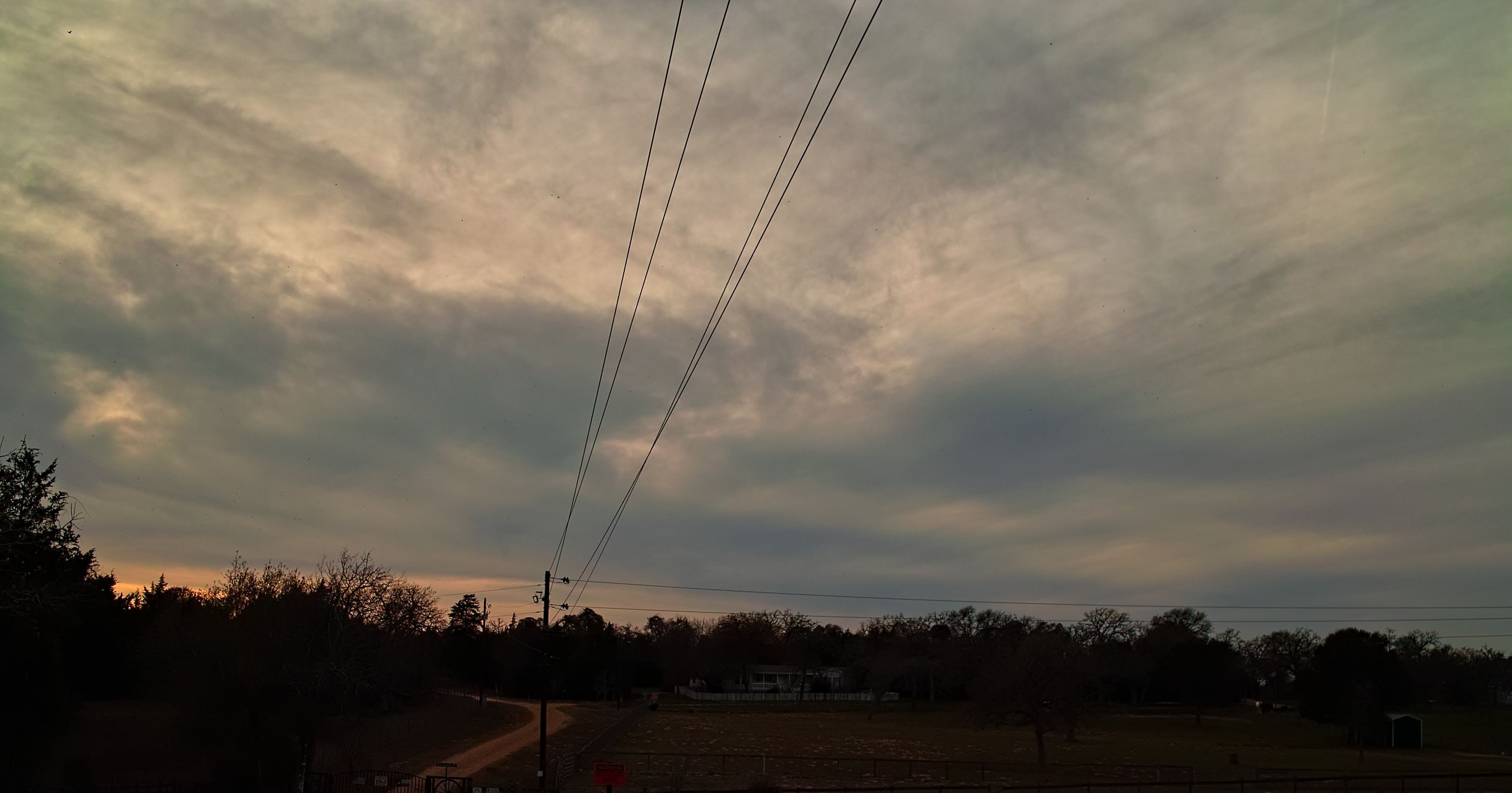
The photo. The sky and its range of tones and the gradation between the tones, makes the image. The tree silhouettes and the lines are bit players (pun alert) that help showcase the sky. The lines to the right give balance to the taller trees on the left. The lines from top centre help our eyes transition down through the tone range of the sky.
From a 2004 4.5mpl camera it is an impressive shot.
Thank you Rich. The light, though it was around noon, was pretty impressive because it came right through those gold and orange leaves, I guess because it was so bright.
Those are nice crops. I actually shot some variations with very similar framing as those, also from the other side. It was too pretty not to make a lot of captures.
I expect there are several. The name of the trail that leads here was Fairyland Trail, and it did seem enchanted.
Thank you Mike. I found it achingly beautiful too. The noon light filtering through those leaves created a magical effect. I would not claim the exposure was perfect but it was maximized for what I was trying to do and what I was trying to do it with.
Your description is about how I shoot most things, on full manual with base ISO, then I play Devils' Deal with the aperture and shutter to figure out what I can live with that won't clip something. With an m43 camera auto ISO is out of the question. Aperture behaves a little differently than with other formats, and shutter speed can go pretty low with the good stabilizer. I did try some blended exposures both in camera and in PS, but wasn't happy with them, they lost a little of the light-magic. I did have to underexpose a bit and brighten in post to get the base file I wanted for further work.
There's a double panorama effect here that works rather well in getting the viewer's attention. First we have a semi panoramic frame to the image and then within that frame we have another panoramic frame around the action. A subjective viewpoint is established.
It's fun to look at and I'd imagine watching a video of the movements would be fun as well.

The image was shot in raw .X3F and converted to TIFF with Sigma Pro Photo 5.5.3. Then edited first with RawTherapee then in the GIMP - a simple blending with a color gradient layer, hence the fancy sky.
Before that it looked like this:
Thank you Mike!
Yes, with a lovely location like you had I also would take numerous shots from different vantage points and focal lengths and then in post see which work best.
A few comments have been about exposure of the sky - which BTW looks fine to me - but the image when downloaded looks like the scene DR was in excess of the camera's capability. So it is that there are a good few bottomed areas too.
This comment is not intended to critique the original but rather to offset any simplistic processing advice, e.g. ETTR ...
And that is why I suggested the alternative to take two exposures using ETTR - one for the sky, one for the non-sky and then blend them in post.
Dan, I think your advice here is in the "teaching your Grandmother to suck eggs" category.
minniev clearly knew exactly how to control her particular camera and the processing she knew she would be using. The proof was in the image.
Thank you Xpat. As you remember the sky, which version is closest? As I said, I've never owned one but the idea behind the Foveon is intriguing.
*I wrote the above and thought I'd do some follow up. Ha. You have been around for a long time mate. I bumped into a 2014 discussion between you and Jim Kasson re Foveon and B&W. Having read the discussion, I'm now considerably less Foveon intrigued. *
I know she knows how to set the exposure to not clip the skies. I acknowledged that in my post about minniev's image.
You were the one who said the exposure needs to be perfect.
My post was in reply to your above opinion in your post, not minniev's post, explaining why the exposure does not need to be perfect.
Here is the link to my post which minniev quoted and it is clearly replying to your and not minniev's post.
dprevived.com/t/wednesday-cc-no-theme-thread-864-revived-084-on-2024-11-06/6419/post/88026/