Amazing!
But the fact that it is medium format does explain a lot.

June 5, 2024
69
-
-

Passengers
-

Everyone is right on all counts. It's chromatic aberration and it shows up around the edges. Most times it is easily fixed in LR. The original is a few years old. Usually when I import images into LR I have the Chromatic aberration correction box ticked. Some years ago I never bothered to do it when importing images. I'll go back to the original file and have another attempt.
-
Here's a better version. LR plus CA correction. Couldn't find the RAW original but I had the jpeg and it cleaned up quite well.
-

Got myself a 2nd hand G9 to do my PL 100-400mm justice.
Today was the first good day out
Google thinks it's an Olive Whistler - I have no idea...
-

This is overlooking Twofold Bay at Eden, Australia, in the late afternoon.

-

Very nice composition, it gives the sense of the infinity, I think this picture will look like better BW.
PS: I commented about fringing but I can see now it has been discussed , so I edited my post -
Another GM5 owner 😎. The coolest camera of the century !!!
-
Nice transition from focused to unfocused areas. I want to get a digital back medium format with manual lenses for different kind of street photography :)
-
Kadikoy Iskelesi ( Kadikoy Pier), I love Istanbul...
-
I agree that the GM5 is a really underrated gem.
I own two of them, snatched them up in a clearance sale.
One is still in the box and will be used when the first is broken.
It is the smallest camera with a pretty good viewfinder that can take such a wide range of lenses (Oy, Pany, ...)
I use it when I want to carry a minimal package (most often with Oly 9-18 and Oly 40-15). -

Discussion of pairing a variety of (old) digital backs with (old) medium format film cameras used to be popular. I wouldn't advise undergoing the pain of trying to do so in 2024 and certainly not as time continues to fugit. Unless, of course you mean a new Hasselblad 907X & CFV 100C outfit, which is brilliant but expensive.
If you want medium format, get a medium format camera. And get your film processed and scanned. My Pentax 645 N was a beast. But I come from a film background and learned to use it long ago when doing so was the mainstream.
Or get a Fuji GFX 100S. (I love mine) Wonderful camera. Absolutely superb lens system. The camera bodies are dirt cheap now that Fuji has come out with their newer models.
Medium format street photography is quite "doable." But I have a real problem with the argument, "I want to use Medium Format because it forces me to slow down and consider each shot and composition, and, and, and."
Anyone can slow down with any camera. Just slow down! Why does it take the camera to make the process go slower? Just slow down and take the care that you would with a slow, big camera.
As for the argument that there is a "medium format look" and that depth of field is shallower with medium format over smaller cameras, just put a good 50mm lens on a full frame camera and shoot at f/1.8 all day (Working slowly, of course).
It'll feel like you're working with MF.
I can show you thousands of images, from Medium Format and Full Frame and you'll only achieve a random chance of identifying which is which. You'll swear the dreamy focus transitions and gorgeous bokeh is from MF, but it will be from FF as often as not.
My Nikon D800E and AF-S Nikkor 50mm at f/2.8-f/1.8 is the best MF camera I've ever shot! (Except for ultimate image quality, which easily goes to the GFX 100S).
Rich
-
Very interesting information. I agree.
Even without Medium Format, or even Full Frame, shallow DOF is achievable with the right combination of lenses and distance.
The Olympus FourThirds F2.0 lenses that I own (ZD35-100 and ZD150) always gave me great looking shallow DOF when desired.
(Come to think of it: I still have them but use them not often enough anymore...)
Also the F2.8 Micro Fourthirds Olympus PRO lenses, and some primes like the 75mm F1.8 and the 45mm F1.8.
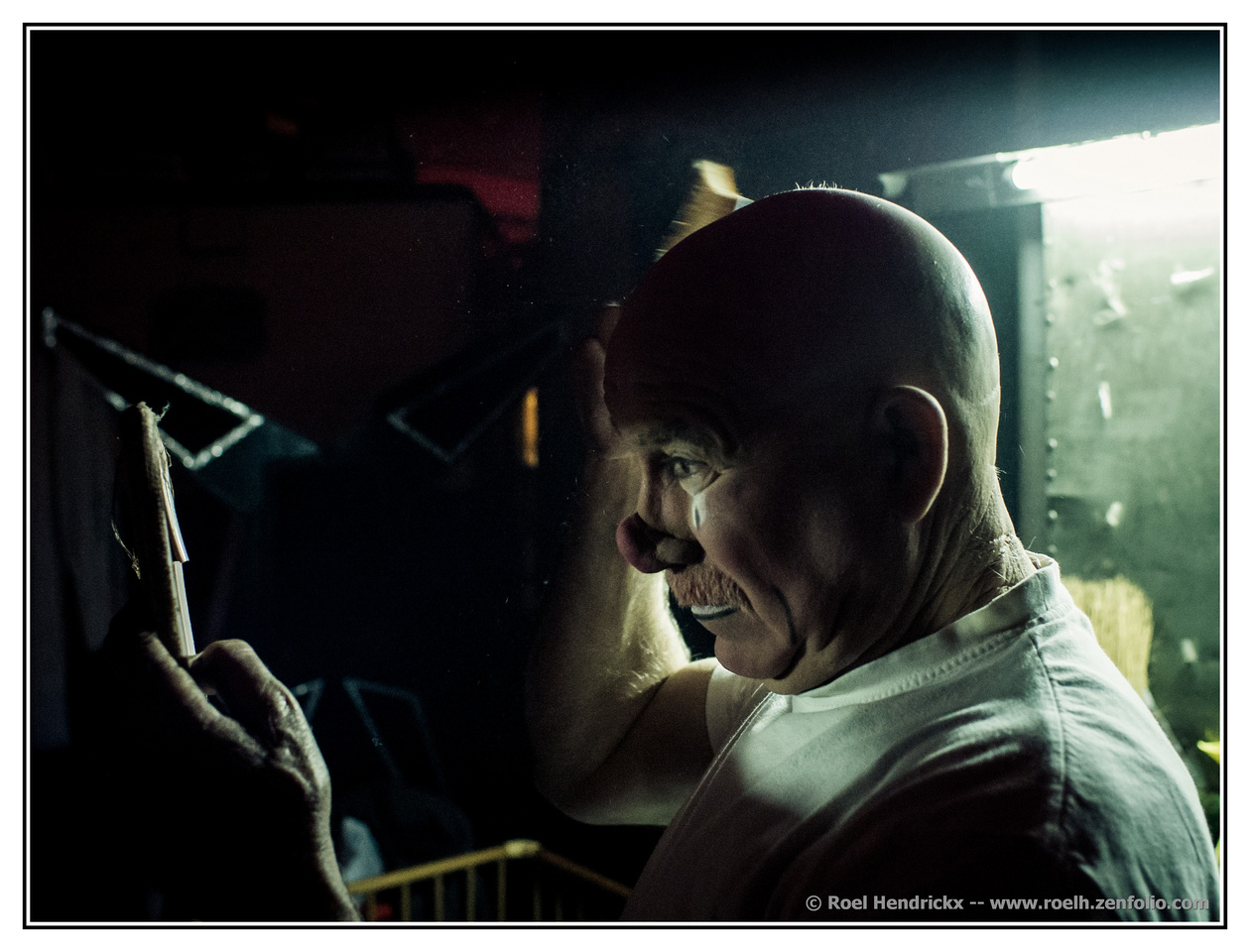
For really impressive lowlight work in the wide angle range, I own the exotic but simply wonderful Voigtlander Nokton 17.5mm F0.95.
It is not really sharp wide open, but the artistic results can be amazing.
I've used it backstage in performance environments, like in a circus and I cannot describe the effect other than "film-like" or "cinematic"
Here's an example (EXIF does not show the aperture because the lens is fully manual - I am guessing this was shot at F1.2 or F1.4):
-
The forces of law and order are in uniforms and lined up with oh so correct correct high vis jackets. They are clearly labelled. We know who the other figure is so we don't need the close up. He's disorder. He's unexpected and doesn't conform. He's in the wrong place. It's the face off between the two that makes the photo. The photographer has carefully selected the angle to make the most of the confrontation.
-
I like the idea of the players in the fog on a deserted beach and I think the composition between the goal posts on the empty beach makes the point. As you say, there are problems with the rendition. Maybe it could be solved by adding a filter to make everything foggier so that the figures become forms in the mist and therefore the details on them no longer matter?
-
Wow. Was he/she really about to dive through the gap or are they coming in for a landing? The bird's positioning is exactly right. A shade more left or right and details that are brought out against the background would have been lost.
The balance provided by the breaking wave, all violence and mayhem, top left is perfect in weight and also as a foil for the control of the bird. -
At another museum in France I was given a stern talking to for including staff in a similar way.
This is a fun juxtaposition.m The vertical orange area on the right balances the sculpture as well. -
Just as Roel said. Plus a mention for the blue stone that provides the focus point, compositionally, tonally and through selective focus.
Are we in Navajho country?


