Y'might want to run that by the movie crews who spend a bunch of time and money lighting scenes to control the exposure...
It must be nice to deliberately post something known to be incorrect and then to bask in the number of responses telling one how wrong one is ...
... is there a particular psychology involved?
This scene has quite good brightness but I feel that the blacks and shadows could have been lifted a little.
Whether anyone feels blacks or shadows in an image they are viewing on their monitor needs lifting or not will depend to some extent on the brightness the monitor is set to.
A given image viewed on a screen calibrated to 80 cd/m2 might look a little dark compared to it being viewed on a screen calibrated to 190 cd/m2 where it might look OK.
@JohnSheehyRev has written: @DonaldB has written:Exposure is not determined by scene luminance. scene luminance is what we are taking an Exposure of. 😉😁 [LOL]
You're trying to create some kind of profundity by oversimplifying things.
It must be nice to deliberately post something known to be incorrect and then to bask in the number of responses telling one how wrong one is ...
... is there a particular psychology involved?
The sad thing is that if you read through DonaldB's posts he genuinely believes his thread title is true 🙂
He basically has his own definition of exposure which is how light or dark an image looks on the medium it is being viewed on.
@PeteW has written:This scene has quite good brightness but I feel that the blacks and shadows could have been lifted a little.
Whether anyone feels blacks or shadows in an image they are viewing on their monitor [need] lifting or not will depend to some extent on the brightness the monitor is set to.
A given image viewed on a screen [set] to 80 cd/m2 might look a little dark compared to it being viewed on a screen [set] to 190 cd/m2 where it might look OK.
I'm wondering how Pete knew what the scene brightness was ...
@bobn2 has written: @DonaldB has written:Open for Discussion.
My comment . the camera is taking the exposure, the scene is what it is.
Just to put this to bed. A useful reference to matters exposure is the Basic Photographic Sensitometry Workbook from Kodak. This from page 2:
@Kodak has written:The unit for light (Illuminance) is called millilux. It is equal to one-thousandth of one lux (formally called a metre-candle). Exposure can be determined by multiplying
Illuminance (in millilux) by Time (in seconds). The equation is:
Exposure = Illuminance x Timebut its irrelevant when your taking a portrait of a black person or a white person, i set the exposure and scene lighting the same even though the
reflective light hitting the camera sensor is not the same, so how can there be a reference for lux to photography ?
Here's one for foot-candles ... easily converted to lux:
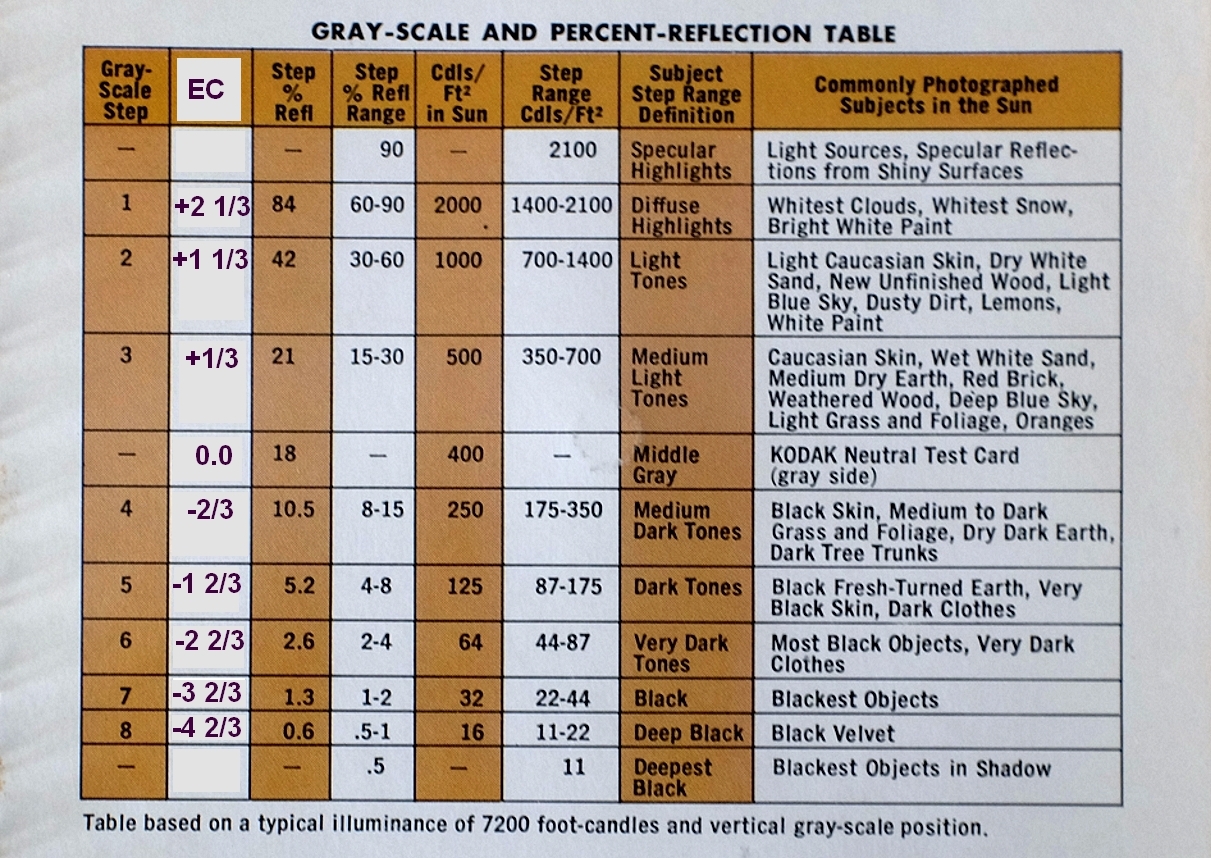
3EV between very black skin and light caucasian skin and yet "I set the exposure and scene lighting the same" LOL
(Hmmm Kodak vs. DonaldB... taka taka taka ...sound of biplane spiraling down etc)
@JohnSheehyRev has written: @DonaldB has written:Exposure is not determined by scene luminance. scene luminance is what we are taking an Exposure of. 😉😁 [LOL]
You're trying to create some kind of profundity by oversimplifying things.
It must be nice to deliberately post something known to be incorrect and then to bask in the number of responses telling one how wrong one is ...
... is there a particular psychology involved?
It's attention seeking:. "Mummy Mummy look at me!"
Don
[deleted]
Just to put this to bed. A useful reference to matters exposure is the Basic Photographic Sensitometry Workbook from Kodak. This from page 2:
@Kodak has written:The unit for light (Illuminance) is called millilux. It is equal to one-thousandth of one lux (formally called a metre-candle). Exposure can be determined by multiplying
Illuminance (in millilux) by Time (in seconds). The equation is:
Exposure = Illuminance x Time
Kodak - a Law unto themselves - why on earth did they choose millilux - a seriously small amount of illuminance?
Are they trying to bring some resolution to starlight or moonlight?
@DonaldB has written:Open for Discussion.
My comment . the camera is taking the exposure, the scene is what it is.
Y'might want to run that by the movie crews who spend a bunch of time and money lighting scenes to control the exposure...
you dont light scenes to control exposure, you light scenes to how you want the subject or scene to look.
@xpatUSA has written: @JohnSheehyRev has written: @DonaldB has written:Exposure is not determined by scene luminance. scene luminance is what we are taking an Exposure of. 😉😁 [LOL]
You're trying to create some kind of profundity by oversimplifying things.
It must be nice to deliberately post something known to be incorrect and then to bask in the number of responses telling one how wrong one is ...
... is there a particular psychology involved?
The sad thing is that if you read through DonaldB's posts he genuinely believes his thread title is true 🙂
He basically has his own definition of exposure which is how light or dark an image looks on the medium it is being viewed on.
come on dunno post your famous post on exposure 😁
@DonaldB has written: @bobn2 has written: @DonaldB has written:Open for Discussion.
My comment . the camera is taking the exposure, the scene is what it is.
Just to put this to bed. A useful reference to matters exposure is the Basic Photographic Sensitometry Workbook from Kodak. This from page 2:
@Kodak has written:The unit for light (Illuminance) is called millilux. It is equal to one-thousandth of one lux (formally called a metre-candle). Exposure can be determined by multiplying
Illuminance (in millilux) by Time (in seconds). The equation is:
Exposure = Illuminance x Timebut its irrelevant when your taking a portrait of a black person or a white person, i set the exposure and scene lighting the same even though the
reflective light hitting the camera sensor is not the same, so how can there be a reference for lux to photography ?Here's one for foot-candles ... easily converted to lux:
3EV between very black skin and light caucasian skin and yet "I set the exposure and scene lighting the same" LOL
(Hmmm Kodak vs. DonaldB... taka taka taka ...sound of biplane spiraling down etc)
that articale has nothing to do with the way i shoot portraits in my studio. and you obviously havnt a clue yourself ,because you cant post
your own experiences. inexperienced photographer. this is pretty basic stuff.
@SrMi has written:Exposure determines how much light hits the sensor. That depends on shutter speed, aperture, and scene light.
Exposure doesnt include scene light. exposure is shutter, and t stop.
What if you are using a flash or studio lights? You can leave the shutter open for as long as I want and have a pitch black file until the flash illuminates the scene, and the length of the flash will determine if there is or isn't any blur in the shot.
you dont light scenes to control exposure, you light scenes to how you want the subject or scene to look.
Take for instance a bullet being captured in flight. You would expose that shot (sorry for the pun) by using a flash rather than a shutter.
you dont light scenes to control exposure, you light scenes to how you want the subject or scene to look.
Earlier I posted an example of how scene luminance affects the exposure* with clear definitions of each.
Other people have also explained why your thread title is nonsense.
You are still running way from posting the definitions of scene luminance and exposure as you used them in your title.
That is what you always do when you have backed yourself into a corner as you have done here.
Your definitions of those 2 are clearly different to most other people's and so you will continue to go round in circles as you are here because obviously you can make up false definitions of those terms that support your thread title.
* exposure - amount of light that struck the sensor per unit area while the shutter was open

@DonaldB has written: @SrMi has written:Exposure determines how much light hits the sensor. That depends on shutter speed, aperture, and scene light.
Exposure doesnt include scene light. exposure is shutter, and t stop.
What if you are using a flash or studio lights? You can leave the shutter open for as long as I want and have a pitch black file until the flash illuminates the scene, and the length of the flash will determine if there is or isn't any blur in the shot.
@DonaldB has written:you dont light scenes to control exposure, you light scenes to how you want the subject or scene to look.
Take for instance a bullet being captured in flight. You would expose that shot (sorry for the pun) by using a flash rather than a shutter.
well from my experience flash duration is maxed at 1/8000 sec. so to slow to still a bullet.
@DonaldB has written:you dont light scenes to control exposure, you light scenes to how you want the subject or scene to look.
Earlier I posted an example of how scene luminance affects the exposure* with clear definitions of each.
Other people have also explained why your thread title is nonsense.
You are still running way from posting the definitions of scene luminance and exposure as you used them in your title.
That is what you always do when you have backed yourself into a corner as you have done here.
Your definitions of those 2 are clearly different to most other people's and so you will continue to go round in circles as you are here because obviously you can make up false definitions of those terms that support your thread title.
* exposure - amount of light that struck the sensor per unit area while the shutter was open
iso effects exposure settings using auto mode .
define amount of light ? give it a value !
exposure - amount of light that struck the sensor per unit area while the shutter was open
thats "AN exposure" = image captured its not exposure (camera settings)