This is what I got on D7200 with a 150mm lens at f/5.6:
The lens is Sigma 50-150 f/2.8 DC OS. At 150mm it's truly telephoto. Bill Claff doesn't have a model for it, but I'm guessing that the exit pupil is 10cm+ from the focal plane.
I halved the height (but not width) of my patch size to give 512x256, as well as using a larger f/ number.
That reduced the "exposure stretch" on my D7200 to 11%.
This makes me more confident about some surprising electronic shutter speed measurements I made on Panasonic S5 (more later) - in these measurements, the electronic shutter speeds have this kind of "exposure stretch". Perhaps to match the mechanical shutter?
In any case, if we're not seeing anything close to 1/8192 over a tiny patch at the centre of the frame, when are we supposed to see it ?
You would have to look into the statistics of your averaged 16 measurements to know about the significance. At least the stretch is "monotonic" roughly doubling when halving the shutter speed. This is consistent with a systematic, constant, lateness of the second curtain. It may be telling that all our cases see lateness. Maybe that is intentional: 50% early would be a full stop underexposed: about 1/16000s, 50% late is roughly half a stop overexposed: the tolerance is more favorable to the late side.
After our results, I do not expect seeing 1/8192s with a mechanical shutter. What we see is less than a third stop off the mark, which is perfectly acceptable for a maximum speed in practical action photography. We can see more accurate shutter speeds with the electronic shutter, where I confirmed it for the D850 and Z7II. One can understand that Nikon only provides an electronic shutter with top models Z9 and Z8, now that they can make a reasonable flash sync speed of 1/200s with electronic shutter.
BTW, I use a 200x200 patch which gives 10'000 pixels in each of the four Bayer subsets. And the 10'000 pixels of the set let expect a 100 fold improved SNR for the DN average as compared to the single pixel DN.
My argument for independence of exposure stretch against aperture, may imply a stretch dependence along the shutter movement direction. One would have to recheck this and perhaps set up a measurement with small patches along the way.
By lack of time, I loose interest for more detail on exposure stretch with mechanical shutters. Surely there are further subtleties and catches with electronic first shutter curtain. Exposure stretch is not a practical problem, even for for my repaired D7200. I learnt, that I can get precise exposures with electronic shutter up to the highest speeds. One might use this to see how consistent stopping down can be with specific lenses: preliminary results taken along with my MTF measurements suggest fairly accurate for electronically controlled apertures.
Mechanical shutters do not move at constant speed, so there may be a lot more complexity to this. On two FF cameras that I've recently seen photographing strobes, the roll of the curtains varies about 2x down the frame! That means that the camera must also be changing the width of the opening as it moves down the frame, to perfectly equalize exposure down the frame. Perhaps this could explain some of the variance. Also, light is not coming perfectly perpendicular to the sensor, so the width of the opening looks different at the top and the bottom of the frame, since the curtains are staggered in height. I don't know if this is controlled for by f-ratio, or just an accepted inconsistency.
The results depend not only on the ratio of exposure and cycle periods, but the depth of the cycle. When lights cut off and on quickly during a cycle, the mismatches with exposure time are the boldest. When the cycle is shallow due to phosphors or circuitry, then small mismatches may be more tolerable, except that with video, a luminance band that is shallow enough to be ignored by the brain in a still may be more visible when it is rolling through the frame.
There the shutter accelerates from about 5m/s at the start of exposure to about 10m/s in the centre of the frame, and remains at about 10m/s until the end of the frame.
I have similar examples from other cameras.
If the acceleration profiles of the first and second curtains can be sufficiently accurately matched, the exposure time is basically the delay between triggering the first curtain, and triggering the second curtain.
At 1/8000.0 s, and 10m/s shutter, the gap between the first and second curtains is 1.25mm.
At 5m/s, the gap between the first and second curtains is 0.625mm.
That's with a premium, fast-moving FF shutter that allows 1/320 X-Sync. (Similar performance to D850 shutter).
I haven't tried precise modelling, but I don't think EFCS-style bokeh truncation problems are possible at realistic f/numbers. Exposure uniformity is an issue, though - the exposure time varies across the frame at high shutter speeds.
Yes - the worst lighting for flicker is low-duty-cycle Pulse-Width-Modulation - strobe-like lighting. That can happen with domestic dimmable LEDs in some cases, but unfortunately also with professional (e.g. theatre) dimmable LED lighting where PWM is used to extend the dimming range below the range available from analogue regulation of the switching power supply that drives the LEDs.
I'm glad I'm a hobbyist, and not a person who is paid to take quality photos in venues with crap lighting systems.
I have a hatred of mains-frequency deep cycling that predates experience with slow-rolling shutters. I discovered back in the '70s that automobile AM radios often had amazing sensitivity and tuning selectivity and I used to listen to stations 200-300 hundred miles away during the daytime and about 1500 miles at night, in my college dormitory with a car radio powered by a 12V filtered power supply. Then, they updated the lighting in my dorm with dimmers, and I could only hear local stations when my roomates wanted dimmed light.
If you have 22000 e- per green pixel, the pixel standard deviation is about sqrt(22000) ~= 148 e-
If we then average these 10000 green pixels, the standard deviation of the average (attributable to shot noise) will be about 148/sqrt(10000) ~= 1.48 e-
The ratio of the standard deviation (attributable to shot noise) to the mean is about 1.48 / 22000 = 0.000067 (about 0.0001 EV).
Which is somewhat below the "rms" shot-to-shot noise that you are seeing (except maybe at high shutter speeds).
Getting the variation in the standard deviation of the replicates down to a level where we can reason about the standard deviations of different treatments needs quite a few replicates: The 𝜒2 confidence intervals for the population standard deviation start out very wide.
This is why I usually end up doing 8 or 16 replicates of each test condition. (And why I use an intervalometer a lot in these tests).
With 4 replicates, a 90% confidence interval for the population standard deviation is [0.62s, 2.92s].
With 8 replicates, a 90% confidence interval for the population standard deviation is [0.71s, 1.80s].
With 16 replicates, a 90% confidence interval for the population standard deviation is [0.77s, 1.44s].
(This being the internet, for all I know, you could be a professor of statistics. If I'm teaching you to suck eggs, I apologise.)
Yeah.
Edited: I misunderstood the number of pixels in the patches Bernard is using - I thought they were 25000 pixels, but it seems they are 10000 pixels.
Edited: Hurried to fix the above, and made another silly error.
Can you be more explicit? Do you mean statistical significance?
The differences I get are quite large compared to the standard deviation of the replicates. The replicate standard deviation estimate is the "G sd EV" column. We can expect the mean EVs for each case to be distributed with sd roughly a quarter of the corresponding "G sd EV" value.
With 16 replicates per treatment, a 90% confidence interval for the treatment mean is: (sample mean) +/- 0.44*(replicate standard deviation).
Stopping down the 15-150 to f/5.6, compared to using the 60mm f/2 wide open adds about 0.01EV noise. (I don't have a manual-only lens that I can use on F-mount).
The D7200 tests I did went down to 11EV (above 1DN). At 11EV, the variation in the replicate means attributable to Poisson noise is in the 8E-5 EV ballpark. So negligible. I could/should use more of the available dynamic range.
I mentioned black level errors before. If I have a 0.5DN black level error at 11EV, that's a 0.00035EV error; if I have a 0.5DN black level error at 6EV, that's a 0.01EV error in a measurement near 6EV. That's at the level of effects I'm trying to detect. I could try gettting more fancy with the statistics, but they would be less robust.
Me neither.
- Which is exactly what I was trying to do when I fell down this rabbit hole. I was particularly looking for EFCS problems.
My first guess is that this is how long each photosite was actively "on", taking charge; IOW, the underlying e-shutter "exposure" time which is partially (mostly, in this case) masked by the mechanical curtains. That number is what you might use to predict dark current noise. Remember, in any digital camera with mechanical shutter curtains, there photosites are active for far longer than they are exposed to light, with fast shutter speeds.
The time between the earliest exposure of any part of the sensor to the latest exposure of any part of the sensor =
(Shutter travel time AKA rolling shutter) + (exposure time).
Your SD9 has an X-sync limit of 1/180. So the Shutter travel time is less than 5.5ms. Probably about 4.8ms.
Your exposure time is "1/6000", or something near 0.2ms.
So the time between the earliest exposure of any part of the sensor to the latest exposure of any part of the sensor =
something less than 6ms, probably a bit less than 5ms.
Definitely nowhere near the 15ms implied by "1/66" s.
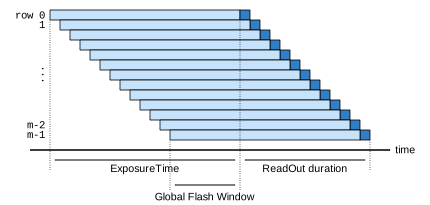
It looks to be exactly like a diagram of the timing of an exposure using electronic shutter, on a camera which reads a row at a time - a typical Active-Pixel CMOS sensor.
In the case illustrated, the exposure time is longer than the (readout-speed limited) (electronic) shutter travel time, so there is a window when the entire sensor is exposed, and the vendor says this is where you should put your flash pulse if you want uniform flash illumination.
We could draw a nearly identical diagram for a film SLR with a mechanical "focal-plane" shutter, when the shutter speed is slower than the X-sync speed.
I have used industrial video cameras in exactly the manner illustrated. The flash freezes the (fast-moving) production line, and gives the effect of global shutter.
I don't know of any mechanical FP shutters that move slowly enough that sensor readout can take place in the time it takes for the shutter to scan the frame. So I don't need the timings on the drawing.